

Plot, structure and pace: three abstract, immovable pillars of the realistic novel. How do you get them right? I’ve spent the summer in various online schools, looking for some answers. In his course The Four Elements of Editing editor and book doctor Andrew Wille (see wille.org) suggests a way to bring the craft of writing and its creativity together, rather than seeing them as separate and to some degree antithetical activities. The four elements are partly derived from Buddhist thinking, and provide a metaphorical way of looking at a novel in draft and how well it is, or isn’t, working. The four elements, and the aspects of the story he suggests they represent, are: Fire (representing the energy of the novel); Water (the emotion); Air (the story’s ideas or abstractions) and Earth (how the story is organised). The aim is for these elements to be held in balance, thereby making the narrative as strong as it can be. Andrew suggests that the categories aren’t fixed — you could have a different number with other qualities — but the point is to bring the issue of editing to life as a creative practice. Your ‘tests’ would give you a way of standing back from what you’ve written, while at the same time getting at its essence.
To apply Andrew Wille’s method I think you’d need to have quite a lot of words already on the page. For How to Plot a Page-Turner, on the other hand, a course taught by Anna Freeman at the London Lit Lab (londonlitlab.co.uk) you need little more than an idea. Although the course included the writing of some scenes and working on the ‘character arc’ of the protagonist in quite a traditional way, as well as identifying key elements of different genres, most of the six-week course was spent on the novel’s plot. Effectively we were asked to write a story about the story we were writing, selecting the main themes, characters and events. You can’t do this without deciding what your story is about, what happens in it, and how it ends; but this miniature narrative need not bear any relationship to any existing, or future draft. Liberated from what I had already written, this version of the narrative began to generate its own ideas. At its most distilled the exercise helps produce the Synopsis, that essential element for approaching agents and publishers.
It also enables you to answer those apparently simple questions, such as ‘What’s your novel about?’ and ‘What kind of novel is it?’ which can seem so reductive and yet so difficult to answer. You will no longer have to mutter in reply: ‘I don’t know really, I haven’t got there yet.’ (This answer will still apply, of course, but you won’t have to admit it.) Anna Freeman is running the same course again starting in November 2021, and I recommend it highly.
By far the most inspiring school I attended this summer was not part of a course at all, but came from a voice in an audio book sent to me by a friend. It’s A Swim in a Pond in the Rain by George Saunders, first published in 2020, subtitled: In Which Four Dead Russians Give Us A Masterclass in Writing and Life.The audio book consists of seven short stories of varying lengths, each read by a different actor, and written by one of the Russian ‘masters’: Tolstoy, Chekhov, Turgenev and Gogol. (The title of the book comes from a scene in Gooseberries, the third Chekhov story in the collection.) After each reading George Saunders analyses the story and how it works, as he has done for the past twenty years of teaching creative writing students at the University of Syracuse in New York.
Throughout the pandemic I’ve found comfort from the sounds of voices reading to me. I don’t recall my parents ever doing this, but over the past eighteen months I’ve spent many of the hours of darkness being transported out of lockdown into other times, landscapes and places, and eventually, when I’m lucky, to sleep. Each of these stories, varying from the very short to the length of a novella, takes you back to the middle of the nineteenth century and a cast of servants, landowners, peasants, lovers, and self-important officials familiar from the masters’ great novels and plays. Saunders’ own voice is witty and sharp but always humane, and he assumes complete equality with the writers in his audience. This despite the fact that Saunders won the Booker Prize in 2017 and most of us are in no way his equal. Not only that, but he manages to imply that anyone trying to write seriously is at some level engaged in the same work as Chekhov.
Saunders begins by explaining why he uses these nineteenth century stories with his students, rather than more contemporary examples (though of course he does this too). Part of the reason is because he loves them, finding them simple, clear and elemental. But he also claims them as literature of resistance. They were written in the repressive culture of the Russia of their times, under constant threat of censorship. What appeals to me most, however, is Saunders’ claim that each of the stories has at its heart the radical proposition that every human being is worthy of attention.
Saunders asks of each of the stories: how does the writer draw you in and keep you reading? How does the writer create meaning? How does he use patterns, and repetition, and variation? How does the story escalate and reach its climax, and at each step, how does the story make you, as the reader, feel? It’s a kind of practical criticism, but the practicality is a different one from showing how clever, or admirable, the story is, or how the story illustrates or fulfils a theory. The listener is encouraged to think how she or he might use such skills in their own writing. Saunders was trained initially as an engineer and I wonder if this is partly why he’s able to describe the abstract, elusive processes of writing in such clear and vivid, everyday metaphors. One key question he considers for his students is how they are going to develop from being talented students to become writers with a unique voice. (He doesn’t actually claim that this will make them successful writers, but one assumes success might follow.) Imagine, he says, that someone offers you an apartment to live in. How do you make it your own? You can try to change everything in it at once, but a better way might be to keep changing it over time, to get to know it well and to make the space express more and more of your unique personality as time passes. To Saunders, editing is a continual and cumulative process, one in which as a writer you get better at hearing your own voice and acting on its behalf.
The longest of the seven Russian stories in the book is Tolstoy’s Master and Man. It’s the tale of an arrogant, self-satisfied, but not particularly evil landowner, who takes a trip in mid winter in a carriage with his put-upon but faithful servant. They encounter various people along the way and repeatedly get lost, as around them the weather worsens by the hour. The master takes no account of warnings, too bent on reaching his destination to secure some financial deal over a piece of land. The servant knows that any advice he gives will be ignored. The reader (or listener) becomes ever more anxious about the fate of the two men. Are they going to survive? The climax of the story is extraordinary. In true Tolstoy style one of the characters is transformed in a moment of unexpected humanity. Saunders analyses this story to discuss how to achieve ‘change’ in a story (and if you do any novel-writing courses, you very quickly learn that for the contemporary market you have to show characters undergoing ‘change’).
To reinforce his analysis Saunders tells a story from his own experience. Once, when he was flying home to Chicago from a conference, Saunders’ plane lost an engine and began to plummet through the sky. Saunders tells us that he was paralysed with terror, convinced that he was going to die. He was filled with agony at the thought of losing a life and family he loved. For a time he was completely absorbed by his own fear, unaware of anyone around him. He says that before this experience he would have liked to feel that he could face imminent death with courage, but when it came to it he felt only fear. Then suddenly he becomes conscious of a teenage boy sitting next to him. The boy asks, in that very quaint American way: ‘Sir, is this meant to be happening?’ And seeing the terror on the boy’s face Saunders suddenly feels like an adult and a parent; someone with the duty to reassure the young. And he does reassure him, even though at that point he doesn’t know whether they will survive. At once he feels less frightened. Saunders says that if he had died at that moment, he would have been a better person than he was before he responded to the boy. He ‘changed’ by becoming more fully himself.
Fortunately for us as well as for him, Saunders’ plane didn’t crash, and with his great generosity he decided to pass on some of the fruits of his two decades of teaching, available for a modest sum to anyone who can afford it (or borrow it from the library). He ends the book by asking himself, as he turns sixty, where he goes from here, and deciding that he wants to continue to devote himself to writing and to trying to help others write. I’d like to think that he might have helped me, but that only time will tell.
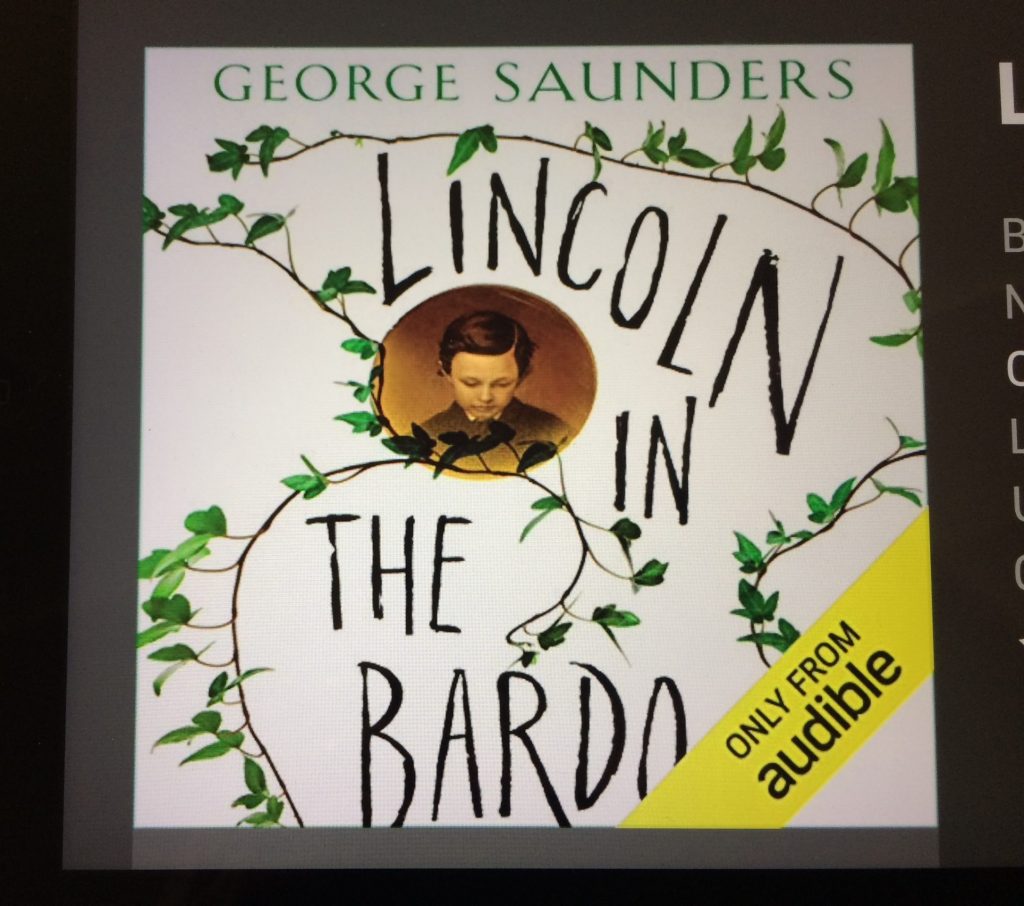
Emboldened by the rich experience of A Swim in a Pond in the Rain I decided to read Lincoln in the Bardo, Saunders’ first full-length work of fiction, which won the Booker Prize in 2017. From the little Saunders says about his own stories while talking about the Russians, I suspected I would find his own fiction tricksy and fantastical and not immediately to my taste. I opted to borrow the audio book version, narrated partly by Saunders himself, in order to allow his voice to help me.
The subject of the book is the death of Abraham Lincoln’s son Willie in 1862. The book is set over one night, much of it in the crypt where Willie’s body is temporarily interred, and where Lincoln is said to have returned repeatedly to hold his son’s body in the extremity of his grief. Beyond this, I would have been pushed to describe plot or structure; and as for pace — well, for some time I kept listening because I felt I owed it to Saunders, rather than because the narrative compelled me to do so. But eventually I was drawn in, fascinated and ultimately moved.
I haven’t counted them myself but according to Wikipedia (which gives a useful summary of the novel) there are 166 characters. Some are taken from actual historical accounts of the time and some created as fictional reporters of historical accounts; others are simply invented. In the world of the novel, some characters are alive and some are dead. They are read by a company of diverse voices and actors as well as by George Saunders himself. They speak in the first, second or third person, repeating and contradicting themselves, looping round and round to some central crisis of their lives, or around the historical events they claim to have witnessed. It is a book about loss, and grief, and grieving; and it’s somehow about the losses of the dead as well as the living. As you read it, you realise that you — that everyone — is part of the dead, as well as the living. It’s not a gothic novel, or a horror story, and despite the use of the bardo, which Saunders himself described in 2017 as ‘from the Tibetan notion of a sort of transitional purgatory between rebirths’ it doesn’t seem to me to be ‘about’ religion.
It’s the diversity and quality of the novel’s many voices, and the respect with which they’re rendered, which links Lincoln in the Bardo to George Saunders’ work as a teacher, and lover of those dead Russians. In Lincoln you can hear the measured, often formal but direct, twentieth century English common to the translations of Chekhov and Tolstoy which Saunders discusses, and which, over the decades, have influenced the way George Saunders himself writes. You can hear echoes in his versions of 1860s American speech and prose. But his style is not archaic: it incorporates other more challenging and more contemporary elements. He’s as direct in talking about sex as he is about death. Serious as the subject matter is, the book, like its creator, is often funny. Underlining this remarkable collage of a novel is the proposition George Saunders shares with the dead Russians, one which remains as radical as ever: namely that every human being is worthy of attention.


0 Comments